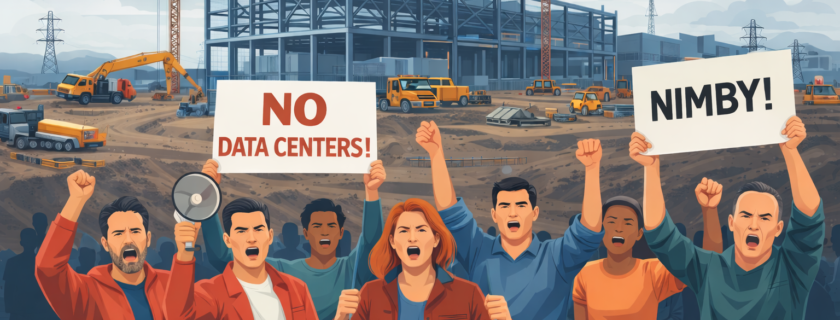
Annual review of rising community resistance—and how developers can de-risk site selection, build trust, and move projects forward
Adam Waitkunas
2025 marked a turning point in the relationship between data center development and the communities asked to host it. What was once treated as a niche land‑use issue became a national flashpoint, driven by rising public awareness, political scrutiny, and organized opposition. Between March and June alone, more than $98 billion in projects across the U.S. and Canada were blocked or delayed, a 125% surge that signaled a structural shift. Community opposition is no longer an occasional entitlement risk; it is now a predictable force shaping site selection, permitting timelines, and long‑term strategy.
Artificial intelligence accelerated this reckoning. As AI demand pushed facilities to grow larger and faster, concerns over power availability, water use, noise, traffic, and transparency moved from technical footnotes to headline issues. As the Brookings Institution observed this fall, transparency has become one of the most decisive factors in whether data center projects advance or stall.
Throughout 2025, Milldam’s Zoning In coverage reinforced a consistent conclusion: the industry’s long‑standing blind spot around community relations did not close—it widened. And in 2026, the consequences will only grow.
What 2025 Made Clear
Across markets, several themes repeated themselves with striking consistency. Communities are far more informed about energy loads, water sourcing, cumulative infrastructure strain, and environmental impacts associated with hyperscale development. At the same time, opposition has become increasingly organized. According to Data Center Watch, nearly 200 community groups across more than two dozen states are now actively opposing data center projects, sharing legal strategies, expert testimony, and messaging across jurisdictions.
Just as notably, secrecy backfired. NDAs, unnamed end users, and opaque development structures repeatedly fueled suspicion and hardened resistance. In contrast, projects that shared credible information early and engaged visibly faced fewer delays and more productive dialogue.
The National Ground Game
Data Center Watch’s 2025 data points to a clear inflection point. Q2 alone saw more project disruptions than the previous two years combined. Opposition surged from Indiana to Georgia, from Arizona to Virginia, driving moratoriums, lawsuits, zoning rewrites, and campaign platforms.
High-profile flashpoints included the withdrawal of a 700-acre Indiana proposal after sustained backlash, data center moratoriums enacted across eight Georgia municipalities, and significant projects in Virginia and Minnesota being delayed amid legal and community pressure. Crucially, opposition proved bipartisan. In multiple states, data centers became campaign issues tied to energy affordability, land use, and environmental oversight. As Data Center Watch analyst Miquel Vila noted, local opposition is no longer anecdotal—it is now a core development variable, on par with land control, power availability, and water access.
Federal Scrutiny Raises The Stakes
By the end of 2025, data centers were no longer just a zoning issue—they had become a political liability. Candidates across party lines won elections by campaigning against unchecked data center growth. Alarmed by these results, Big Tech and industry trade groups responded by ramping up lobbying and advertising at unprecedented levels, seeking to reframe data centers as job creators and economic engines.
But events on the ground told a different story. In places like Chandler, Arizona, nationally coordinated messaging failed to overcome local distrust. What mattered most to residents was not slogans, but whether they felt informed, respected, and protected before decisions were made. The lesson was unmistakable: you cannot out‑message a trust deficit.
That trust deficit is now under federal scrutiny. Earlier this month, Senators Elizabeth Warren, Chris Van Hollen, and Richard Blumenthal launched an investigation into whether Big Tech data centers are contributing to rising residential electricity costs by shifting the burden of grid expansion onto consumers.
Enhancing Data Center Community Engagement in 2026
The projects that advanced in 2025 treated community relations as a risk mitigation strategy, not a public relations tool. Transparency must come first; NDAs must strike a balance between confidentiality and clarity. Executives must engage early, and commitments must be measurable.
At Milldam, these principles underpin our Community Risk & Readiness Assessment, helping developers identify political, regulatory, and stakeholder risks early—before opposition hardens into delay or cancellation.
De-Risking Community Protest During Site Selection
One of the most effective ways to reduce community protest is to address it before a site is finalized, not after a project is announced. Community sentiment analysis should be a formal part of the data center site-selection process—conducted alongside environmental, utility, and real estate due diligence. This means capturing and analyzing online conversations, local news coverage, and social media discourse to understand the tone, concerns, and narratives already forming within a community. These early signals often reveal whether residents are primed for growth, skeptical of development, or already mobilized around issues such as water use, energy reliability, land preservation, or transparency.
Equally important is identifying who shapes local opinion. Beyond elected officials, many opposition movements are driven by organized interest groups, informal neighborhood leaders, environmental advocates, and ratepayer watchdogs that frequently appear in media coverage and online forums. At the same time, there are often potential allies—business groups, labor organizations, chambers of commerce, and economic-development entities—that understand the economic stakes and can provide balance if engaged early. Mapping these stakeholders and understanding their motivations enables developers to prioritize outreach, anticipate potential pressure points, and avoid being caught off guard once a project becomes public.
Finally, site-selection intelligence should draw on lessons learned from prior development efforts, both successful and unsuccessful. Communities rarely experience development in isolation; past projects—whether industrial, energy, logistics, or data centers—leave behind narratives, grievances, and trust gaps that shape how new proposals are received. When available, drawing on insights from previous developers, utilities, or municipalities that have navigated local approvals can provide critical context. Milldam’s experience shows that projects which incorporate this kind of community intelligence early are far better positioned to avoid costly delays, legal challenges, and reputational damage later in the entitlement process
A Serious Approach to Trust and Transparency
One of the clearest lessons from 2025 is that process secrecy is increasingly being mistaken for bad faith. While NDAs and confidentiality remain essential for protecting competitive positioning, land negotiations, and customer relationships, overly restrictive disclosure has become a flashpoint in many communities. Residents don’t need proprietary schematics or customer names—but they do need enough information to understand what’s being built, why it’s needed, and how it will affect their town.
The industry needs to find a workable middle ground: narrower NDAs that protect true trade secrets while allowing developers to proactively share non-competitive facts about scale, infrastructure demands, timelines, mitigation plans, and community benefits. Transparency, when done thoughtfully, lowers the temperature and deprives opponents of the “black box” narrative that so often fuels distrust.
Equally important, companies must stop hiding behind consultants and attorneys once a project goes public. Communities expect to see real executives—decision-makers with authority—show up, listen, and engage. When leadership remains invisible, it reinforces the perception that something is being concealed. In contrast, visible, accountable executives who participate in town halls, small-group meetings, and one-on-one conversations can humanize projects and demonstrate long-term commitment. As Milldam’s community intelligence work consistently shows, trust is built through presence, not press releases
Coalition Building
Successful projects rarely move forward on developer voices alone. The most effective approvals in 2025 were supported by broad, locally rooted coalitions that reflected the economic and civic fabric of the community. Chambers of commerce, business improvement districts, workforce organizations, construction trades, and regional economic-development groups often carry far more credibility with elected officials than outside developers—especially when they can speak to jobs, tax base stability, and downstream business growth.
Developers should also more intentionally leverage utility partners as trusted validators. Electric and water utilities are already deeply embedded in local conversations around growth, reliability, and ratepayer impact. Their public-affairs teams typically have a strong pulse on community sentiment, active stakeholders, and political fault lines. When aligned early, utilities can help clarify infrastructure realities, correct misinformation, and frame projects within broader grid-planning and resilience discussions—rather than leaving developers to defend these issues alone.
The data center industry enters 2026 with extraordinary demand—and far less margin for error. AI is accelerating deployment timelines at the very moment communities, regulators, and voters are raising expectations around transparency, accountability, and local value.
The next wave of successful projects will not be defined by who secures land fastest or scales power most aggressively. They will be determined by who earns trust earliest—before NDAs harden suspicion, before narratives take hold, and before opposition becomes political.
In 2026, the real competitive edge is no longer measured in milliseconds or uptime. It’s trust—and it must be earned long before ground is broken.
Take a Deeper Dive on The Data Center Richness Podcast
Many of these themes were explored during my conversation with Rich Miller on Data Center Richness. Watch here: https://www.youtube.com/watch?v=syRpAj9aCSg&t=1614s
