-Adam Waitkunas
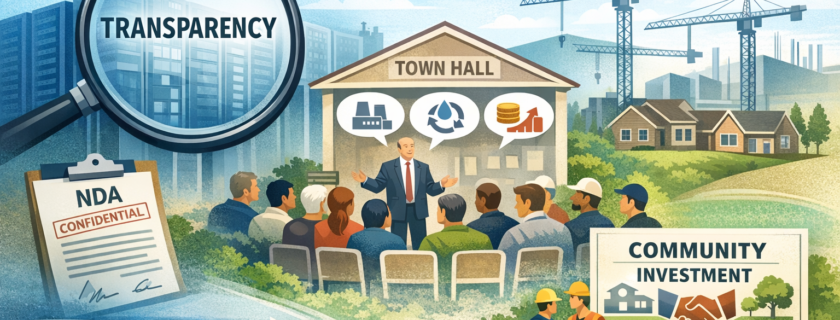
As community opposition delays tens of billions of dollars in data center investment, developers are discovering that NDAs alone no longer protect projects—they often undermine trust. This piece explores how transparency, Community ROI, and executive visibility can be integrated into site selection and due diligence to reduce entitlement risk.
For years, non-disclosure agreements have been treated as an unavoidable feature of data center development. NDAs protect competitive positioning, land negotiations, customer relationships, and power strategies. In many cases, they are necessary.
But as community opposition to data center development has grown more organized, more political, and more successful, NDAs have taken on a second role; one the industry can no longer afford to ignore. Increasingly, they are perceived not as legal safeguards, but as signals that something important is being hidden.
In today’s entitlement environment, secrecy is no longer neutral. It is interpreted as intent.
The scale of this shift is no longer anecdotal. According to Data Center Watch, community pushback delayed or blocked more than $98 billion in AI data center investment in just three months in mid-2025, affecting 20 major projects, more than all disruptions tracked since 2023. National coverage has since described a “data center rebellion,” driven largely by bipartisan opposition in rural and exurban communities where residents feel blindsided by project scale, infrastructure impacts, and incentive packages they do not fully trust.
Across the U.S. and Canada, communities are asking a common question long before permits are filed: What aren’t we being told? When projects surface late, wrapped in confidentiality and accompanied by limited public detail, residents fill the information vacuum themselves—often with worst-case assumptions about power use, water demand, diesel generation, noise, and long-term expansion.
Recent national reporting reinforces this pattern. In multiple communities now opposing AI data centers, residents say they were initially told projects would resemble little more than warehouse buildings, only to later discover—sometimes by visiting facilities in neighboring towns—the scale of generators, cooling equipment, and outdoor infrastructure that had not been clearly explained upfront. Once that realization occurs, opposition is no longer just about mitigation; it becomes about credibility.
When NDAs Become a Liability
From Milldam’s Zoning In analysis and on-the-ground community-relations work, projects that unravel on transparency tend to follow a familiar trajectory.
Large proposals such as Digital Gateway and Project Tango did not fail solely because of scale. They became flashpoints because information emerged unevenly and too late. NDAs constrained early disclosure, and by the time details became public, trust had already eroded. Local officials were left exposed, residents assumed the worst, and opposition groups mobilized quickly.
Similar dynamics have played out in Arizona, the Midwest, and parts of the Southeast. Projects advanced quietly through early land and utility discussions under tight confidentiality, only to surface publicly once power, water, or environmental implications were perceived as locked in. In these cases, NDAs may have protected negotiations, but they also created the impression that communities were being asked to react rather than participate.
At that point, NDAs stop functioning as legal instruments and start functioning as political symbols. Once secrecy becomes the story, it is tough to reverse the narrative.
An Industry Signal—And a Test
It’s notable that some of the largest players now appear to recognize this shift. This week, Microsoft announced a “Community-First AI Infrastructure” initiative, committing to “pay its way” on electricity, minimize and replenish water use, support local jobs, contribute to community tax bases, and invest in workforce development and nonprofits—precisely the issues that most often become flashpoints when projects advance under NDAs and limited disclosure.
The announcement is an important signal that the trust gap is now being treated as a business risk, not just a communications challenge. At the same time, it’s essential to place these commitments in context. As industry analysts have observed, many of the principles Microsoft outlined—around energy responsibility, water stewardship, and operational discipline—have long been considered best practices in hyperscale data center development. Other technology companies, including IBM, have made similar environmental and social commitments over time.
What’s changed is not necessarily the substance of the commitments, but their elevation and consolidation into a more explicit, community-facing framework. In that sense, Microsoft is less redefining data center strategy than acknowledging that trust, transparency, and stakeholder engagement have become first-order considerations alongside cost, speed, and scale. The real test will be whether these commitments show up consistently at the local level, embedded early in site selection, utility coordination, and permitting conversations, with metrics and outcomes that communities can actually see.
That distinction matters because communities don’t judge commitments on intent; they judge them on execution.
Transparency Done Differently
By contrast, developers who embrace early, structured transparency—without abandoning NDAs—often face a very different outcome.
Projects advanced by Rowan Digital Infrastructure in Temple, Texas, illustrate this approach. Before formal filings, Rowan engaged city leadership and local stakeholders around campus scale, infrastructure sequencing, construction impacts, and long-term build-out assumptions. Customer identities and final power contracts remained confidential, but the company was explicit about what could be shared, what could not, and why. Just as importantly, Rowan paired transparency with listening—adjusting elements of site design and buffering based on early feedback.
Equally important, senior leadership showed up. Communities were not asked to absorb major land-use and infrastructure changes through slide decks or third-party representatives alone. When residents had hard questions—about growth, mitigation, and long-term accountability, executives were present to answer them directly. That visibility did not eliminate opposition, but it materially changed the tone of the conversation. Concerns surfaced earlier, trust was built faster, and speculation had less room to take hold.
A similar playbook has been used by Compass Datacenters across Central and North Texas, where early engagement often included senior decision-makers alongside technical experts. By pairing authority with transparency—and explaining not just what decisions were being made but who was accountable for them—Compass was often able to shift conversations from suspicion to substance before opposition hardened.
Transparency did not eliminate resistance. It changed the trajectory.
Why Community ROI Has Become Central
Transparency alone, however, is no longer enough.
One of the most consistent themes in recent opposition campaigns is skepticism around tax abatements and incentive packages. Communities increasingly question whether the benefits being promised justify the impacts they are being asked to absorb, particularly when job creation is modest and infrastructure costs are immediate.
Opponents are framing incentives not as investments, but as subsidies that externalize costs onto residents through higher power bills, water strain, or environmental risk. Whether those claims fully hold up is often beside the point. Once communities believe the ROI case has not been made clearly, trust erodes rapidly.
This is why Community ROI must be treated as a core transparency pillar.
In Temple, Rowan framed incentives within a longer-term fiscal narrative, outlining projected tax contributions as abatements phased out and how utility investments tied to the project supported broader municipal goals. Similarly, Compass has tied ROI discussions to locally relevant outcomes such as tax base stability, infrastructure alignment, and sustainability commitments—rather than abstract economic multipliers.
The common thread is specificity. Communities may debate whether the ROI is sufficient, but they are far less likely to assume it is illusory when the value exchange is clearly articulated.
Why a Framework Is Now Necessary
Perhaps most telling is that opposition groups themselves increasingly describe their success as a function of persistence and shared strategy. As one recent report put it: “Never give up.” Communities are learning from one another, borrowing tactics, and organizing earlier in the development lifecycle.
At the same time, policymakers and regulators are signaling that the industry is losing control of the narrative—particularly around energy costs, transparency, and local value. In that environment, improvisation is no longer a viable strategy.
Developers need a repeatable, defensible framework that anticipates skepticism rather than reacting to it.
A Practical Transparency + ROI Blueprint
What follows is not a universal solution, but a framework developers can integrate into site selection and early due diligence.
1. Define Information Tiers Early
- Always shareable: site boundaries, land use, maximum build-out, construction impacts
- Shareable with context: power and water ranges, sustainability goals, expansion scenarios
- Protected by NDA: customers, final contracts, competitive siting strategy
- Explain why each boundary exists.
2. Be Explicit About NDAs
Communicate what NDAs protect, who requires them, when limits may lift, and what will never be hidden.
3. Replace “No Comment” With Process Transparency
Share timelines, regulatory milestones, and decision points even when details are constrained.
4. Engage Before Filings
Pre-application outreach surfaces concerns while they are still solvable.
5. Equip Local Officials
Provide NDA-safe FAQs, visuals, and talking points so leaders are not left exposed.
6. Make Community ROI Concrete
Clearly articulate:
- long-term tax base impacts
- infrastructure investments tied to community priorities
- realistic job and workforce pathways
- timelines for when benefits materialize
- Distinguish incentives (inputs) from ROI (outcomes).
7. Put Executives in the Room
One of the most underappreciated drivers of trust is who shows up.
Communities do not want to hear exclusively from third-party consultants, technical vendors, or carefully worded written statements. They want to hear directly from the people making decisions—and who will be accountable long after approvals are granted.
Developers should:
- Ensure senior executives attend key public meetings and listening sessions
- Empower leadership to answer difficult questions, even when the answer is “we don’t know yet”
- Clearly identify who owns long-term commitments on power, water, mitigation, and community investment
- Treat executive presence as a signal of respect, not a box-checking exercise
When executives show up early—before opposition hardens—they humanize the project, reduce speculation, and demonstrate that community concerns are being taken seriously at the highest level. When they don’t, residents often assume decisions are already final.
The Bottom Line
Transparency is no longer a courtesy. It is a form of risk management.
Developers who treat NDAs as immovable shields—and delegate community engagement entirely to intermediaries will continue to lose public battles, often before they realize one has begun. Those who treat transparency, Community ROI, and executive visibility as design constraints—built into site selection, due diligence, and early engagement—will be better positioned to earn trust and move projects forward.
The future of data center development will not be decided by who shares the most information—but by who shares enough, early, and with intent—and by who is willing to show up and stand behind it.
Milldam Perspective
At Milldam, we see this dynamic play out every week through Zoning In and in our work supporting developers, utilities, and infrastructure investors navigating local opposition. Bridging the gap between confidentiality and trust is no longer a communications exercise—it’s a core component of site selection, entitlement strategy, and long-term risk management. Learn about Milldam’s Data Center Community Risk & Readiness Assessment and see how you can implement these techniques for your next project.
