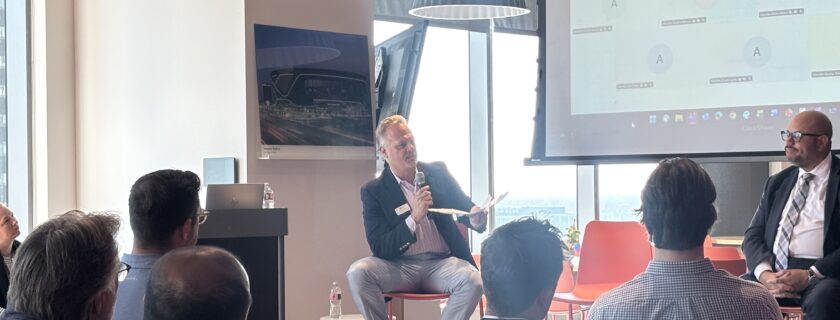
Thank you to everyone who joined the 7 x 24 Exchange Southern California Chapter last month for our California data center policy briefing held at Arup’s downtown Los Angeles office. The event brought together developers, operators, utilities investors, legal advisors, and policy stakeholders for a discussion on how California’s shifting regulatory landscape is reshaping data center development.
California data center load is expected to grow from roughly 1,000 MW today to approximately 4,500 MW by 2040, fueled by AI, cloud computing, and the state’s broader digital economy. But as demand accelerates, so does legislative scrutiny. Several pending bills are predicted to reshape how projects get built:
- SB 887 would eliminate existing CEQA exemptions for data centers, requiring full environmental impact reports in most cases, potentially adding 12 to 24+ months to project timelines.
- SB 886 targets large-load customers over 25 MW, introducing new requirements around demand response, dispatched zero-carbon supply, and long-term funding commitments, shifting utility and grid capacity risk onto developers.
- AB 1577 and AB 2619 would mandate new energy and water use reporting, with AB 2619 carrying added weight since inaccurate water reporting could expose applicants to personal liability.
- AB 2170, while currently stalled, signals where environmental justice review may be headed for projects near overburdened communities.
Beyond the legislation itself, the discussion showed that site selection is no longer just about land power and fiber. Developers are increasingly weighing entitlement risk, utility capacity, water availability, and proximity to sensitive communities before committing to a location. Behind-the-meter power is also drawing more attention, since utility interconnection timelines can now stretch three to five years or longer. However, self-generation brings its own emissions, permitting, and community concerns to manage. Community benefit and development agreements are likely to become a more common tool for securing local support and long-term project certainty.
Our panelists, Nedda Mahrou of Mayer Brown, Joshua Romero of Western Digital, Michael Kerkorian of Utility Cost Management, and KC Roestenberg of Orange County, offered practical perspectives on navigating this environment, with Olivia Schuster of Arup opening the program with a legislative overview and Mildam’s own, Adam Waitkunas moderating the discussion.
The clear takeaway is that projects most likely to succeed will be fully funded, utility-ready, low-impact, and backed by early, transparent community engagement. As one panelist noted, communities do not want to learn about a project first through a public hearing notice; by then, opposition may already be forming.
Thank you again to Arup for hosting, DPR construction and Milldam Public Relations for support, and to everyone who joined us for an important conversation on the future of data center development in California.
