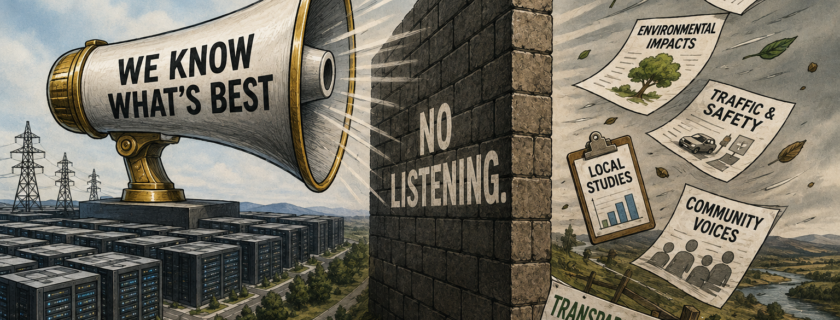
At the exact moment the data center industry needed credibility, transparency, and listening, one of its most visible advocates delivered accusations, controversy, and a whole lot of hubris.
By Adam Waitkunas
For an industry already battling a growing trust deficit, the last thing data centers needed was a public relations disaster led by one of the most recognizable personalities in business television.
Yet that is exactly what happened in Box Elder County, Utah.
Over the past several months, the proposed Stratos Project, championed by investor and television personality Kevin O’Leary, has evolved from a major economic development announcement into a case study on how not to introduce a large-scale infrastructure project to a community.
And perhaps the most remarkable part is that the lessons were entirely avoidable.
When You Become the Face of an Industry
Most controversial projects remain local stories.
This one didn’t.
Because Kevin O’Leary is not just another developer. He is a celebrity investor, television personality, and media fixture with millions of followers and virtually unlimited access to national news outlets.
That visibility matters.
When O’Leary speaks, people listen.
When O’Leary attacks critics, people listen.
When O’Leary accuses project opponents of being connected to Chinese interests, people listen.
And when he later admits he has no evidence to support those claims, people listen to that too.
The problem is that retractions rarely receive the same attention as accusations.
The damage is already done.
And because O’Leary became one of the most visible public advocates for data center development in America, the fallout extends beyond a single project in Utah. It becomes a reflection of the industry itself.
That should concern every developer, investor, operator, and policymaker involved in data center development.
The Original Sin: Assuming People Would Simply Say Yes
One of the most common mistakes developers make is assuming communities will automatically embrace a project because it promises jobs, investment, tax revenue, and economic growth.
By his own admission, O’Leary fell into that trap.
Earlier this month, he acknowledged that he and project supporters “really screwed this up initially” and made assumptions that were “just not right.” He admitted they expected residents to be excited about a multi-billion-dollar investment and were unprepared for the intensity of the opposition that emerged.
That statement alone should be required reading for every developer entering a new community.
Developers often view projects through the lens of economics.
Communities view projects through the lens of impact.
Developers see investment.
Residents see traffic.
Developers see jobs.
Residents see water consumption.
Developers see tax revenue.
Residents see power demand, environmental impacts, noise, and quality of life concerns.
Neither perspective is inherently wrong.
But ignoring one of them almost always is.
Two Ears. One Mouth.
The data center industry has a listening problem.
Too often, developers arrive armed with renderings, economic impact studies, tax revenue projections, and talking points before they’ve spent five minutes understanding what matters to the people who actually live in the community.
Before listening, they start selling.
Before asking questions, they start providing answers.
Before understanding concerns, they begin dismissing them.
That’s backwards.
Communities do not want to be told what is good for them.
They want to be heard.
The first question should never be:
“Here’s why this project is great.”
The first question should be:
“What concerns do you have?”
That simple shift changes everything.
It transforms a presentation into a conversation.
It transforms opponents into stakeholders.
And in many cases, it transforms a project that was headed toward conflict into one that has a chance of earning trust.
The irony of Box Elder County is that many of the concerns eventually addressed by project supporters were concerns residents raised from the very beginning.
The community was telling the developers exactly what they needed to hear.
The developers simply weren’t listening.
Dismissing Concerns Never Works
Unfortunately, the project’s response to opposition only deepened the divide.
Rather than engaging critics directly and seeking to understand their concerns, project supporters frequently suggested that opposition was driven by misinformation, outsiders, or hidden agendas.
The most damaging moment came when O’Leary publicly suggested that groups opposing the project could be connected to Chinese interests seeking to undermine America’s AI development and infrastructure expansion.
It was an extraordinary accusation.
It was also unsupported.
Last week, O’Leary publicly acknowledged that he had no evidence that Alliance for a Better Utah, Elevate Strategies, or several individual project critics were funded by China or the Chinese Communist Party.
The clarification was necessary.
But it arrived after weeks of headlines, controversy, and public distrust.
By then, the damage had largely been done.
The lesson is straightforward.
When residents raise concerns about water, land use, environmental impacts, power consumption, or community character, dismissing them rarely makes those concerns disappear.
More often, it validates them.
Transparency Is Not a Recovery Strategy
To his credit, O’Leary eventually recognized many of these mistakes.
He publicly admitted the rollout was mishandled.
He acknowledged that environmental concerns should have been addressed from the beginning.
He agreed to significantly reduce the project’s footprint.
He committed to greater transparency.
Those are all positive developments.
The problem is that transparency works best before trust is lost—not after.
Community engagement is not a crisis communications strategy.
It is not something that can be bolted onto a project after opposition reaches a boiling point.
It is a core project development discipline.
Once residents believe they have been ignored, dismissed, or misled, rebuilding trust becomes exponentially more difficult.
A Warning for the Entire Industry
What happened in Box Elder County should not be viewed as an isolated controversy.
It is part of a broader trend unfolding across the country.
Communities are becoming more organized.
Opposition groups are becoming more sophisticated.
Local officials are becoming more cautious.
And policymakers are paying closer attention.
Across the United States we are seeing:
- Moratoriums on new data center development
- Citizen-led referendum efforts
- Local zoning restrictions and outright bans
- Increased state legislative activity
- Congressional scrutiny
- Delayed, scaled-back, and canceled projects
The old playbook is no longer working.
Announce the project.
Promise jobs.
Highlight tax revenue.
Dismiss concerns.
Label critics as misinformed.
Hope opposition fades away.
That approach is failing repeatedly.
And if the industry continues down this path, it should expect more moratoriums, more project delays, more bans, more restrictive legislation, and more public resistance.
The data center industry has become exceptionally good at scaling infrastructure.
What it has failed to scale is community engagement.
The biggest lesson from Box Elder County isn’t about water, power, AI, or even data centers.
It’s about listening.
Because if one of the most visible business personalities in America—with virtually unlimited resources, media access, and political connections—could not successfully introduce a project of this magnitude without creating a national backlash, then every developer should be asking themselves a simple question:
Are we listening enough before we start talking?
Because trust, once lost, is much harder to restore than a server.
Learn more about Milldam’s Data Center Community Engagement offerings.
