The data center industry has standardized just about everything. There are established frameworks for uptime, redundancy, resiliency, and operational reliability.
Organizations like the Uptime Institute created a common language that helps operators, customers, and other stakeholders understand what a Tier III or Tier IV facility actually means. The standards are measurable. They are repeatable. And they are trusted. As the industry races to build the infrastructure powering the AI economy, there’s one area where almost no comparable standard exists: community engagement. That gap is becoming increasingly costly.
More than $150 billion in data center investment was delayed or blocked in the second half of 2025 alone as local opposition intensified across the country. The trend has only accelerated in 2026. In the first quarter, at least 20 proposed data center projects were canceled following community pushback, representing more than $41 billion in investment and 3.5 gigawatts of projected power demand.
Over the past three years, more than $85 billion in projects have reportedly been canceled after facing some form of organized local resistance. What was once viewed as isolated opposition is rapidly becoming a defining challenge for the industry. And increasingly, it has less to do with the technology itself than the process surrounding it.
A recent Gallup survey found that seven in 10 Americans oppose data centers being built in their communities, with nearly half saying they strongly oppose them. Even more striking, respondents indicated they were now more comfortable living near a nuclear power plant than a data center. Whether fair or not, that perception gap should be setting off alarm bells across the industry. Because projects are no longer being evaluated solely on economics, tax revenue, or infrastructure demand. They are increasingly being judged on trust, transparency, and perceived alignment with the communities where they are proposed. And right now, there is no universally accepted playbook for how developers are supposed to earn that trust.
Some companies engage early and effectively. Others rely heavily on NDAs, limited disclosure, and highly technical presentations that do little to address public concerns around water usage, power consumption, land use, noise, environmental impact, or overall quality of life. Too often, communities feel they are being brought into the process after key decisions have already been made. Once that perception takes hold, projects quickly become vulnerable — not just to neighborhood opposition, but to political and regulatory escalation.
Maine nearly became the first state in the country to enact a statewide moratorium on large-scale data centers after legislation passed both chambers before ultimately being vetoed by the governor. The significance of that episode is not that the bill failed. It’s that it almost succeeded, creating a legislative template other states can now follow.
At the same time, lawmakers in states including Virginia, Georgia, Oregon, Vermont, and South Carolina have introduced various moratoriums, pause-and-study bills, and restrictions tied to large-load projects, grid capacity, and ratepayer protections. Local governments are simultaneously adopting their own freezes and zoning restrictions, creating a two-front battle that can reshape development timelines overnight.
The proposed Sentinel Grove Technology Park in Florida became one of the clearest examples of this new environment. Despite billions in projected investment and extensive concessions related to water infrastructure and site design, the project ultimately collapsed following mounting public and political opposition.
This is no longer a niche issue playing out in a handful of hyperscale markets. Community opposition to data centers has become nationalized.
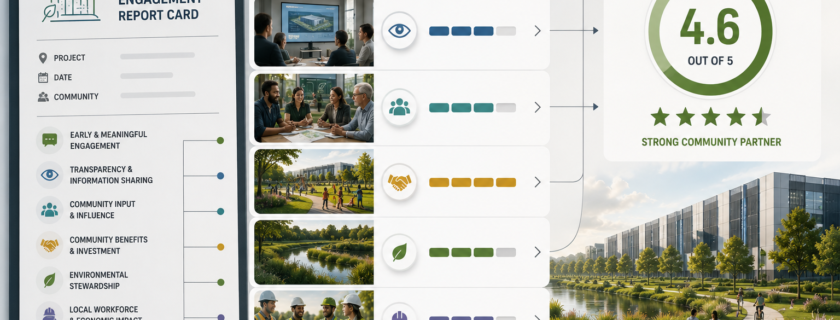
That is why the industry should seriously consider adopting something it has never had before: a standardized, independently validated framework for community engagement. In other words, a missing tier.
A Community Engagement Certification framework would not exist to create more bureaucracy or slow development. It would exist to create consistency, accountability, and credibility in an environment where public trust is rapidly eroding.
At a minimum, such a framework could establish baseline standards for stakeholder engagement, transparency, public communication, community benefit planning, and ongoing accountability after approvals are secured. It could require developers to conduct meaningful pre-development outreach, provide accessible public-facing information about infrastructure impacts, and engage communities before opposition narratives become entrenched, and it would need to be independently validated.
Without third-party verification, community engagement claims are just marketing language. But a neutral body — similar to the role the Uptime Institute plays operationally could provide municipalities and residents with confidence that projects are following a defined and accountable process.
Too often, community benefit commitments emerge late in the process as reactive concessions under political pressure. By then, skepticism is already high, and trust has already eroded. A standardized framework could shift those conversations earlier by requiring benefits to be informed by actual community input and tied directly to the concerns driving opposition — infrastructure strain, environmental impacts, construction management, schools, public services, and quality-of-life protections. That changes the conversation from transactional negotiation to long-term community alignment.
The data center industry often talks about speed to market, but increasingly, the biggest threat to timelines is not permitting logistics or power availability. It’s perception. Perception that decisions are being made behind closed doors. Perception that communities are being informed rather than engaged. Perception that the local impact is being minimized while the benefits are overstated. Whether those perceptions are accurate almost becomes secondary once they solidify politically.
And that is the real shift happening right now: entitlement risk is no longer just technical or political. It has become reputational and community-driven.
If the industry does not create its own standards around engagement, transparency, and accountability, those standards will increasingly be imposed externally — by legislatures, regulators, courts, and ballot initiatives.
The next era of data center development will not be won solely on power, land, or speed to market. It will be won on trust.
