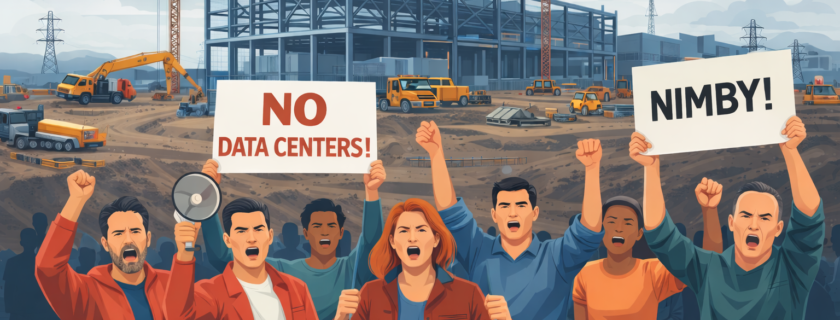
This week’s Zoning In highlights how data center development is increasingly colliding with local politics and regulatory scrutiny. In California, the city of Monterey Park moved forward with a ballot measure to ban data centers citywide. In Utah, the Provo City Council denied a zoning change that would have allowed a new facility, while Michigan’s Gibraltar adopted a one-year moratorium to give officials time to establish development standards.
Across several other communities—from Wisconsin to Pennsylvania—packed public meetings and town halls reflected growing demands for transparency around energy use, environmental impacts, and economic benefits. Taken together, the stories show how local engagement, planning frameworks, and political buy-in are becoming central factors in whether projects move forward.
Hundreds of residents attended a heated public hearing over the proposed Wildcat Ridge data center campus in Archbald, Pennsylvania. The project would include 14 buildings and extensive generator infrastructure, drawing questions about water use, economic benefits, and environmental impacts.
Residents and local officials challenged the developer’s job projections and financial assumptions, while the company defended the project’s economic contributions.
Monterey Park City Council approves ballot measure to prohibit data centers
The Monterey Park City Council unanimously voted to place a ballot measure before voters that would ban data centers citywide. If approved in a June special election, the measure would amend the city’s general plan to prohibit facilities of any size.
The decision follows strong public opposition to a proposed data center project near residential neighborhoods and comes amid warnings from the developer that the move could trigger legal challenges.
Environmental groups seek more details of plan to sell Chantilly land for data center
A coalition of environmental groups is pressing Fairfax County officials for more transparency around a proposed sale of 42 acres of county-owned land in Chantilly to a data center developer. Advocates say too little information has been made public about the terms of the deal, how it originated, and what the long-term environmental and community impacts could be.
The proposal has also sparked broader questions about whether the land could serve another public purpose, including affordable housing or other county priorities. The dispute underscores how land disposition decisions tied to data centers are drawing scrutiny well before formal project plans are even filed.
Goodyear moves to regulate data centers with new noise, distance rules
Goodyear, Arizona is moving to update its zoning rules for data centers and battery storage projects as more cities in the Phoenix region revisit how these facilities are regulated. The proposed changes reportedly focus on issues such as setback requirements and noise controls.
The move comes as data center growth continues in the West Valley, where Goodyear already hosts multiple campuses and another project under construction. It reflects a broader trend of fast-growing markets tightening local rules as digital infrastructure expands deeper into developing suburban areas.
Residents raise concerns about humming noise near South Jersey data center
Residents in Vineland, New Jersey say a persistent humming sound they believe is coming from a nearby data center construction site is disrupting daily life and sleep. Neighbors have reported the issue to county health officials, who are investigating the source of the noise.
The company behind the project says the facility is operating within local noise ordinance limits and is implementing additional sound mitigation measures.
Provo City Council denies zoning change for proposed data center
The Provo City Council voted to deny a zoning change that would have allowed construction of a new data center in the city’s East Bay area. Council members cited concerns about environmental impacts, power demand, and broader economic development priorities.
Officials said they want more time to study the city’s long-term economic strategy before approving additional data center projects, though the developer could potentially resubmit a revised proposal in the future.
A suburb rife with data centers set to fight Amazon plan for another
Local officials in Loudoun County, Virginia — home to the world’s largest concentration of data centers — say they were “blindsided” after George Washington University sold its 120-acre Ashburn campus to Amazon for $427 million. The tech giant is widely expected to pursue plans for a new data center on the property, though the site is not currently zoned for one.
The announcement has sparked immediate political resistance in a county that has long benefited from data center tax revenue but is increasingly grappling with power demand, land use concerns, and voter fatigue with new projects. Local supervisors say approving another facility in the area could be “political suicide,” setting up what may become a high-profile zoning battle in the industry’s most mature market.
Festus data center proposal and agreement leaves residents considering legal action
Residents in Festus, Missouri are exploring legal options to challenge a proposed data center development near their homes. Community members have raised concerns about noise, water use, light pollution, and potential health impacts, while critics say local officials have not been transparent about negotiations with the developer.
Opponents have formed an advocacy group and are reviewing public records to determine whether the city complied with open-government laws. The dispute reflects a growing pattern of organized local opposition using legal strategies to challenge data center projects.
AI is spurring a big expansion of high-voltage power lines. Landowners and locals are fighting back
The rapid growth of AI-driven data centers is fueling a nationwide expansion of high-voltage transmission lines — and triggering a new wave of local resistance. Utilities say large new power corridors are essential to meet rising demand, but landowners and environmental groups are increasingly pushing back against towers, easements, and potential use of eminent domain.
From Pennsylvania to Texas, opposition groups argue the infrastructure primarily benefits large technology companies while disrupting farms, property values, and natural landscapes. Analysts say the conflicts could slow grid expansion just as electricity demand from data centers is expected to surge, adding another layer of complexity to the industry’s growth.
Community Opposition Emerges as New Gatekeeper for AI Data Center Expansion
Community resistance is increasingly shaping where — and whether — new data centers can be built. Recent project battles in places like San Marcos, Texas; New Brunswick, New Jersey; and Montour County, Pennsylvania show local activism, zoning changes, and moratoriums stopping or delaying projects that once would have been routine approvals.
The trend suggests a structural shift in the development landscape, where community sentiment now functions as a critical “gatekeeper” for AI infrastructure. Concerns about power demand, water use, environmental impacts, and limited local economic benefits are driving opposition campaigns that can stall projects long enough to threaten financing or force developers to relocate.
Data center, gas station store moratoriums extended in metro Atlanta community
Officials in Newton County, Georgia have extended a moratorium on new data center proposals while local leaders review zoning and development regulations. The temporary pause prevents developers from submitting applications or seeking rezonings for new projects.
County commissioners say the delay will give them time to study infrastructure impacts and craft updated rules governing large developments. The move reflects a broader trend of local governments using temporary moratoriums to slow the pace of data center expansion while evaluating long-term policy frameworks.
A University of Tennessee researcher has received a $1 million Sloan Foundation grant to study the economic, social, and energy impacts of data center development across the Southeast. The three-year project will examine how growth in Tennessee, Georgia, and Virginia is affecting rural communities and regional energy systems.
Researchers will analyze factors including utility planning, policy frameworks, and community impacts as data center construction accelerates in the region. The study aims to provide policymakers with clearer data as states weigh the benefits and trade-offs of hosting large digital infrastructure projects.
The DATA Act of 2026 and the Future of Data Center Development
A new federal proposal — the Decentralized Access to Technology Alternatives (DATA) Act — would allow large electricity users such as data centers to build privately financed, off-grid power systems exempt from many federal utility regulations. The approach is designed to accelerate infrastructure development while shielding existing ratepayers from rising energy costs.
While the bill could help developers bypass lengthy interconnection queues, it would not override state and local permitting rules and could face scrutiny over reliability and oversight concerns. The proposal reflects growing federal attention to how energy policy must evolve to support the rapid expansion of AI infrastructure.
Data Center Developers Battle For Hearts And Minds For Their Projects
Developers are increasingly investing in community outreach as local opposition becomes a major factor in project approvals. Speaking at Bisnow’s Data Center Investment Conference & Expo Southeast, industry leaders acknowledged that weak early engagement has contributed to rising pushback across many markets.
Analysts estimate that $98 billion in data center projects were delayed or blocked in 2025 due to community resistance. Developers now say proactive engagement — including town halls, local partnerships, and visible community benefits — is becoming essential to securing zoning approvals and maintaining development timelines.
PA lawmakers must do more to protect residents from data centers
This opinion piece argues that Pennsylvania lawmakers have failed to put meaningful safeguards in place as data center development accelerates across the state. The author contends that data centers threaten to raise household electricity costs, increase pollution, strain water supplies, and impose significant local impacts without adequate transparency or consumer protections.
The piece calls for a far more aggressive policy response, including stronger regulation, limits on new development, and clearer rules to ensure residents are not left subsidizing infrastructure upgrades or absorbing environmental and public health risks. It reflects the increasingly sharp tone of the policy debate in Pennsylvania as data center growth collides with energy and community concerns.
Legislators weigh plans to reduce data center costs for Ohioans
Ohio lawmakers are considering bipartisan legislation aimed at shielding residents from the cost impacts of rapid data center growth. One proposal would prevent utilities from passing data center-related infrastructure costs on to other customers, while another would study broader issues including noise, light pollution, health concerns, and safety.
The push comes as Ohio communities voice growing concerns over the energy and water demands of large facilities and whether ordinary ratepayers are being asked to subsidize them. The debate signals how statehouses are increasingly stepping into the data center conversation as local opposition intensifies.
Alliant Energy ordered to reveal more details about Meta’s Beaver Dam data center
Wisconsin regulators have ordered Alliant Energy to provide more information about how it plans to serve Meta’s proposed $1 billion data center campus in Beaver Dam. The case centers on the utility’s proposed contract arrangement with Meta and how costs, rate structures, and project details are disclosed to the public.
The order reflects increasing regulatory scrutiny over how utilities structure large data center power deals and whether enough transparency exists around the financial implications. As more hyperscale projects move forward, utility proceedings are becoming another important battleground in the industry’s expansion.
Pennsylvania AI Data Center Legislation in 2026: What Companies Need to Know
Pennsylvania lawmakers are weighing a growing slate of bills that could reshape how data centers are proposed, reviewed, and powered in the state. The legislation under discussion includes annual energy and water reporting, model local ordinances, pre-application meeting requirements, water impact studies, zoning protections near residential areas, utility oversight, and even a proposed three-year moratorium on hyperscale development.
The article frames Pennsylvania as a major emerging battleground where state policy, community sentiment, and energy politics are converging quickly. For developers and operators, it is a reminder that government affairs strategy and local engagement are becoming just as important as site selection and power access.
Adams County data center gets federal permit, as voters sign petitions to block it
A proposed data center project in Adams County, Ohio has received a federal permit from the U.S. Army Corps of Engineers, even as local opponents ramp up petition drives aimed at blocking the development. The permit includes conditions tied to wetlands, protected species, and nearby cemeteries, but critics say the review is moving ahead before residents have had a meaningful chance to weigh in.
Opposition in the county is taking multiple forms, from calls for rural zoning and local moratoriums to broader concerns about light pollution, environmental damage, tax treatment, and whether data centers would deliver meaningful long-term economic benefit. The fight illustrates how resistance is escalating even before formal project applications are fully in place.
Festus data center proposal and agreement leaves residents considering legal action
Residents in Festus, Missouri are considering legal action as opposition grows to a proposed data center project near homes in Jefferson County. Neighbors say they are concerned about water use, noise, light pollution, health impacts, and what they see as a lack of transparency surrounding the city’s agreement with the developer.
At a recent community meeting, an attorney outlined possible legal avenues, including Missouri Sunshine Law claims and nuisance arguments. The fight reflects a familiar pattern in which community opposition is increasingly shifting from public protests and petitions to potential courtroom challenges.
Protesters oppose AI data centers coming to Spartanburg Co.
Residents in Spartanburg County, South Carolina gathered to protest future AI data center development even after TigerDC withdrew its proposed $3 billion Project Spero campus. Protesters say the halted project was only one example of what may be coming and are signaling they intend to remain organized and vocal.
The demonstration shows how opposition movements are increasingly persisting beyond a single project, evolving into broader campaigns aimed at discouraging similar proposals from taking root in the future.
Allies of TSN urges community to speak out against STREAM data center project
Opponents of the proposed $19.46 billion STREAM data center project at STAMP in Genesee County, New York are urging residents to intensify their public comments and show up in force at upcoming hearings. Advocacy groups tied to the Tonawanda Seneca Nation say the project raises major concerns around land use, environmental review, and the scale of public incentives being offered.
The campaign is also pressing local boards to conduct a more rigorous and transparent site plan review. The dispute highlights how large incentive packages and environmental review processes are becoming major flashpoints in data center siting battles.
Pekin’s mayor announces data center project will not move forward
The mayor of Pekin, Illinois announced that the city will not move forward with a proposed data center project after weeks of vocal public opposition. Residents had raised concerns about environmental impacts, power costs, and noise, while supporters had emphasized potential tax revenue, jobs, and broader economic benefits.
The decision was met with applause at a city council meeting and marks another example of local officials stepping back from a project after sustained community backlash. It also underscores how public sentiment is increasingly becoming a decisive factor, even when officials see economic upside.
Fire department turns down $250,000 Google donation amid data center fight
A volunteer fire department in the Rock community near Sand Springs, Oklahoma turned down a $250,000 donation from Google amid an ongoing fight over a proposed data center. The department’s chief said accepting the money could have undermined trust with residents who have been opposing the project over traffic, safety, and quality-of-life concerns.
The episode shows how contested projects are spilling into broader community institutions, where even philanthropic gestures can be viewed skeptically if they arrive in the middle of a heated local fight.
East Whiteland residents oppose data center as planners send revised plan back for further review
Residents in East Whiteland Township, Pennsylvania packed a planning commission meeting to oppose a revised proposal for a large data center near homes and businesses. Opponents raised concerns about property values, power demand, health effects, and the scale of the project, which would grow from roughly 1 million square feet to nearly 1.7 million square feet.
The planning commission declined to advance the revised plan immediately, instead sending it back for further review. While the project itself is already approved, the debate shows how amendments and expansions can reopen political and public scrutiny even after an initial entitlement has been secured.
Residents of Chester County community voice concerns over massive AI data center
A separate report on the East Whiteland controversy highlights the intensity of community concern over the proposed expansion of the already approved Sentinel Green Fig project. Residents at a packed public meeting voiced worries about property values, utility costs, and environmental effects tied to the larger 1.6 million-square-foot proposal.
Together with the 6ABC coverage, the story reinforces how even in cases where zoning is already in place, major data center projects can face strong organized resistance when the scale increases or public awareness catches up.
‘Fundamental misunderstanding’: Oracle refutes recent media reports about Abilene data center
Oracle is pushing back on reports suggesting delays at its Abilene, Texas AI data center, saying the coverage reflects a “fundamental misunderstanding” of how AI data centers are built and upgraded. The company said the site remains on schedule and that 200 megawatts are already operational.
The statement is notable because it shows how closely watched major AI infrastructure projects have become and how quickly questions about pace, scale, and expansion plans can shape the broader narrative around high-profile developments.
Monroe County expected to OK new data center rules
Monroe County, Georgia is expected to approve new development standards for future data centers following extended discussion among county commissioners. Officials postponed a final decision earlier this month to allow attorneys to incorporate additional conditions into the draft rules.
The move reflects a broader pattern of local governments updating zoning and development standards as they try to get ahead of future proposals rather than reacting after projects have already arrived.
Data center moratorium bills are spreading in 2026
This roundup argues that moratorium proposals are rapidly spreading across the country as lawmakers grapple with the costs and impacts of hyperscale data center growth. According to the article, at least a dozen states are now considering statewide pauses on new projects while officials study grid impacts, water use, land conversion, tax incentives, and local control.
The piece frames moratoriums as a sign that policymakers are becoming far more skeptical of the industry’s traditional growth model. Whether or not all of these proposals advance, the trend shows that “pause first, regulate later” is becoming a much more common political response to data center expansion.
Residents press Hamilton County leaders on downtown AI data center, Jailhouse Studios plan
Residents in Hamilton County, Tennessee are raising questions about a proposed AI data center that would be part of a larger redevelopment plan to transform the former county jail into a film, music, and technology complex known as “Jailhouse Studios.” The project, led by Urban Story Ventures, is pitched as a billion-dollar mixed-use development combining digital infrastructure with creative industry space.
Community members told county commissioners they want more transparency about the lease terms, job commitments, and long-term economic benefits before the county moves forward. Officials have not yet taken a vote on the proposal.
The community of Denver neighbors organizing against a data center
Neighbors in Denver are organizing against a CoreSite data center project under construction in the Globeville Elyria-Swansea neighborhood, raising concerns about pollution, diesel backup generators, and cumulative environmental impacts in a community that already faces heavy industrial exposure.
Local organizers say the issue goes beyond a single facility and reflects broader questions about environmental justice and how cities decide where digital infrastructure should be located. The debate illustrates how data center siting is increasingly intersecting with long-standing environmental equity concerns.
Gibraltar passes data center moratorium: Facility proposed at former McLouth Steel site
Gibraltar, Michigan has adopted a one-year moratorium on data center development as officials evaluate how to regulate the facilities. The move comes as a developer proposes a 100-megawatt data center at the former McLouth Steel industrial site.
Supporters say the pause will give planners time to establish zoning standards and review potential infrastructure impacts. Opponents argue the project could increase electricity costs and harm nearby wildlife areas, even though the site would reuse previously industrial land.
Environmental groups protest sale of county land for a data center
Environmental groups in Fairfax County, Virginia are pushing for greater transparency around a proposed $166.8 million sale of county-owned land in Chantilly for a data center development. Critics say the deal moved forward with limited public disclosure due to confidentiality provisions in the agreement.
Advocates are asking county officials to release more details about the transaction, including infrastructure requirements, environmental impacts, and whether alternative uses for the land were considered.
Independence voters sue city clerk over blocked referendum on $150B data center incentives
Residents in Independence, Missouri have filed a lawsuit seeking to force the city to allow a referendum on incentives tied to a massive proposed data center campus. The project would span roughly 398 acres and could eventually produce up to 800 megawatts of power.
Opponents attempted to trigger a public vote after the city approved an ordinance authorizing billions in development-related financing, but officials said the measure was not eligible for referendum under the city charter. The lawsuit asks a judge to compel certification of the petition.
Data Center Planning and Development Must Recognize Local Authority and Infrastructure Realities
County officials in Maryland are pushing back on proposed statewide legislation that would require jurisdictions to develop formal data center planning frameworks and environmental reporting systems. Local leaders argue the proposal could impose unfunded mandates and undermine local land-use authority.
The testimony emphasizes the need for a collaborative regulatory approach that acknowledges infrastructure constraints such as power, water, and transportation capacity while preserving local decision-making authority.
Columbus City Council hearing spotlights debate over data center expansion
Columbus officials held a lengthy public hearing on the rapid expansion of data centers across central Ohio, where roughly 18 facilities already operate in the city and more than 100 exist across the broader region.
Residents voiced concerns about energy demand, water usage, and environmental impacts, while industry representatives highlighted economic benefits and job creation. City leaders say they are trying to strike a balance between supporting digital infrastructure growth and addressing community concerns.
Residents voice concerns about potential data center at information session
Residents in Beloit, Wisconsin gathered at a public information session to discuss concerns about a potential data center project in the area. Speakers raised questions about environmental impacts, electricity demand, and the broader burden large facilities could place on local infrastructure.
State lawmakers attending the meeting echoed calls for greater transparency and more detailed analysis before any project moves forward.
Dodge County residents pack forum to learn about Meta data center in Beaver Dam
A packed public forum in Dodge County, Wisconsin highlighted growing community interest in Meta’s planned billion-dollar data center in Beaver Dam. Residents asked questions about potential impacts on air quality, water resources, and electricity rates.
While some attendees expressed openness to the project’s economic benefits, others said they were frustrated that details about the development emerged late in the process.
Maine bill blocks data centers from state tax breaks
Maine lawmakers are considering legislation that would prevent data centers from qualifying for two major state tax incentive programs designed to attract job-creating businesses. Supporters of the bill argue that data centers do not generate enough long-term employment to justify the subsidies.
The proposal comes as the state also considers a temporary moratorium on large data centers while policymakers study the industry’s impacts on energy, water, and local communities.
Minnesota data centers: Bill proposes ban on officials entering nondisclosure agreements
Minnesota lawmakers are considering a bill that would prohibit cities and counties from signing nondisclosure agreements with data center developers. The proposal follows controversy in St. Louis County, where officials signed an NDA related to a potential Google data center project.
Supporters say the legislation is needed to improve transparency and ensure residents are informed about major development proposals. Business groups warn the change could complicate early-stage site selection negotiations.

