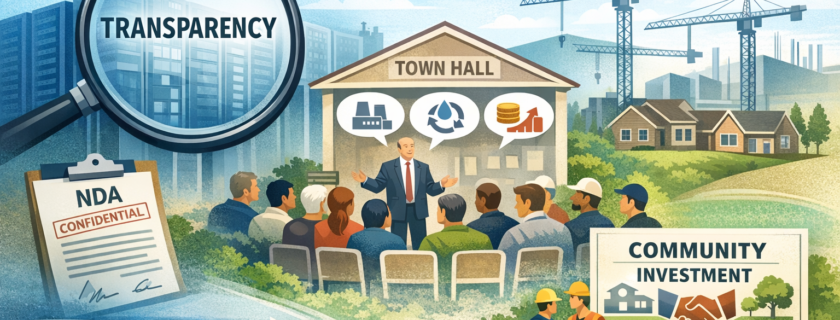
This week’s Zoning In shows the data center debate continuing to shift into a more overtly political phase. From Sand Springs to Monterey Park, communities are signaling that opposition is no longer just about individual projects. It’s about process, trust, and transparency, with residents increasingly willing to escalate fights beyond planning boards and into ballot measures, recalls, and sustained organizing.
Across markets, three forces keep converging: local control, fiscal exposure, and infrastructure accountability. Cities are demanding clearer guardrails before approvals, counties are reopening incentive math in public hearings, and states from Florida to Indiana and South Dakota are reexamining tax breaks, zoning authority, and who pays for grid upgrades.
Meanwhile, developers are pushing ahead in more receptive states, such as Mississippi, creating a widening divide between jurisdictions, tightening scrutiny, and those racing to capture investment, even as opposition remains durable after approvals, and polling suggests a large, persuadable middle is still up for grabs nationally.
Your Data Center Development Is Being Sued. Now What?
In his latest blog, Adam Waitkunas examines a scenario that has become all too familiar in the data center world: projects landing in court before they ever break ground. The piece explores how litigation reshapes public perception, fuels opposition, and drives real cost and schedule risks—while providing a blueprint for a practical communications playbook to stay aligned with legal counsel and protect long-term community relationships as cases unfold. Check out the full piece here.
Recall effort launched in Sand Springs over data center controversy
Opposition in Sand Springs has escalated from angry meetings to a full-on recall push targeting the entire city council—a signal of how quickly “local process” fights can become governance fights. The core dynamic: residents saying they were dismissed, and now using the strongest democratic lever available.
McLinko: Bradford County trying to stay ahead of data center surge
In northern Pennsylvania, officials are attempting something rare: getting in front of the wave before a project formally lands. With land deals and “exclusive marketing rights” in play near a power plant, the questions are already familiar—taxes, water, noise, aesthetics—plus a warning from past experience: “We were promised the sky and the moon.”
GCEDC approves public hearing on Stream data center tax incentives
Genesee County’s economic development board advanced plans for a public hearing on a major incentive package tied to Stream’s proposed STAMP data center project. The story highlights the scale of requested abatements/exemptions (offset by PILOT payments), projected long-term revenues/benefits for local entities, and visible public opposition showing up early in the process.
Fayetteville Planning Commission Denies Data Center Conceptual Site Plan
Fayetteville’s Planning & Zoning Commission voted 3–2 to deny a conceptual site plan for a proposed 300,000-square-foot data center after a vocal public turnout raised concerns about traffic, noise, visual impacts, and water use. The broader meeting also included annexation/industrial park discussion where officials emphasized certain zoning actions were not intended to allow a data center.
Voters could decide fate of proposed Monterey Park data center
Monterey Park is edging toward the ultimate escalation: taking the data center question directly to voters. With a moratorium already in place and a ballot-path now being explored, the fight is shifting from planning and permitting to pure politics—jobs vs. utilities vs. quality-of-life, decided at the ballot box.
Sheboygan-Amazon warehouse deal approved, residents petition in opposition to any potential data centers
Sheboygan’s Common Council approved a land deal with Amazon for a project labeled a logistics/warehouse facility, but residents remain skeptical and fear it could become a data center. Opponents are now collecting 5,000 signatures demanding clearer “guardrails,” more transparency, and assurances the site won’t be used for data center development.
STCC Residents Organize Town Hall Meeting regarding Data Center Issues
Residents organized a town hall after supervisors postponed a public hearing and granted a 90-day extension tied to a proposed amendment to the township’s data-center overlay (centered on 54 Airport Road). The meeting focused on whether changes to the overlay could expand where data centers could go, plus concerns around emergency response readiness, water supply, karst/sinkholes, noise/traffic, property values, and the need for a centralized website for updates and documents.
Marysville weighs data center impact on water, offers 15-year tax break
Marysville is still negotiating safeguards for a proposed data center on nearly 600 acres, including infrastructure access funded by the developer and guardrails to ensure local water systems aren’t strained. The other pressure point is incentives: the city has offered a 15-year, 100% tax abatement on the building, while projecting significant land-tax revenue compared with the current-use baseline.
Sterling Heights passes moratorium on data centers
Another Michigan city hits pause—this time preemptively—so planners can study impacts before any application arrives. Officials framed the move bluntly: better to slow things now than scramble later once Pandora’s box is open.
Data center moratoriums pile up in Michigan. No one knows if they’ll work
Michigan’s data center pushback is becoming statewide and explicitly political: moratoriums are spreading, tax breaks are under fire, and candidates are staking out positions. Even supporters are starting to say the quiet part out loud—communities want local input and protections, or developers will simply move on to friendlier ground.
Metrobloks says its data center is not Big Tech, but residents still tell them to “go home”
A neighborhood meeting in Indianapolis shows how fast the “good neighbor” narrative can collapse when trust is already thin. Residents pushed back hard on claims of collaboration—especially given brownfield history and environmental baggage—turning the debate into a blunt referendum: if the community says no, why keep pushing?
Pushback against Microsoft’s proposed data center in Dorr Township continues
In rural Michigan, opponents are organizing early and framing the fight as protection of farmland, water, property values, and “Pure Michigan” identity. Microsoft points to closed-loop cooling and community plans—but the local posture is clear: change zoning first, slow everything down, and make the company prove the case.
Harwood residents voice transparency concerns over AI data center
Even after approvals and construction, Harwood residents say they’re still missing basic clarity on the deal and its implications. The project pitch (jobs, tax base, infrastructure) is colliding with a lingering perception that the process moved too fast—another reminder that “winning approval” isn’t the same as earning legitimacy.
Baltimore County pauses data center development
Baltimore County just hit pause—unanimously—until it can study impacts and draft rules. The takeaway isn’t just the moratorium; it’s the institutional language: data centers are now officially “divisive,” and local governments want proof on environmental and economic tradeoffs before issuing more permits.
Amid proposals and deals, a grassroots movement to stop data centers intensifies in Arizona
Arizona is becoming a case study in fast-scaling opposition: large crowds, organized coalitions, and narratives tying AI infrastructure to water, power, pollution—and distrust of closed-door dealmaking. Even where projects move forward, the broader message is spreading: people want oversight, not inevitability.
Bill allowing data centers, other projects on “poor” farmland soil heads to Indiana Senate
Indiana lawmakers are debating a bill that would reduce local hearing requirements for major projects on farmland deemed “poor” soil. Regardless of intent, this is gasoline on an already-hot fire: it reframes data centers as a local-control fight, not just an infrastructure one.
American Tower withdraws data center plans in Pike Township
Community pressure (and pending zoning revisions) helped force a retreat—at least for now. The subtext: even mid-size projects can become flashpoints, and “withdrawn” doesn’t mean “gone,” which keeps communities on alert for the next filing.
Norwalk plans privately funded $12B data center, promises jobs and tax revenue
Norwalk is moving quickly to secure a massive, privately backed project while annexation is still under appeal—because developers won’t wait. The pitch is classic (tax revenue + jobs, no incentives), but the early resident questions are also classic: lighting, buffers, fences, and recourse once the machines arrive.
States Rethink Data Center Tax Incentives as Costs Soar
The incentive conversation is shifting from “how do we win projects?” to “how much are we giving up, and what are we getting back?” Virginia is the bellwether—huge fiscal exposure, multiple bills in play, and a likely near-term emphasis on transparency + standards rather than a full repeal (for now).
Poll: Virginians favor tougher regulations on data centers
Public opinion in Virginia is hardening, with majorities favoring tougher siting restrictions (including buffers around parks/historic sites). This is the direction of travel: data centers moving from “economic development asset” to “land-use and quality-of-life issue” in voters’ minds.
Goldwater Institute Warns Local Regulation Could Threaten Arizona’s Data Center Growth
A pro-growth counter-narrative is emerging: local restrictions, they argue, risk pushing investment elsewhere while demand remains. In other words, the policy fight is now two-sided and organized—grassroots opposition on one side, policy groups warning against “backlash regulation” on the other.
Florida Senate advances bill to regulate data centers amid concerns over energy and water use
Florida lawmakers are moving to require hyperscale facilities to fully cover grid upgrades and face new water-use permitting—while business groups warn of overregulation. The split reflects a widening national fault line: protecting ratepayers versus keeping states competitive for AI investment.
Ashville Village Council rejects annexation tied to proposed data center project
In Ohio, a council vote blocked annexation tied to a major proposal after residents raised economic, health, and safety concerns. Even with a separate parcel still in play, the message was clear: community voice is now a decisive gatekeeper in entitlement fights.
Potential Microsoft data center sparks concerns among Dorr Township residents over land conversion
Farm conversion, private wells, light and noise pollution—neighbors in rural West Michigan are mobilizing early as Microsoft explores a large campus. Township fact sheets haven’t quelled skepticism, underscoring how speed of disclosure now shapes trust as much as technical details.
As tech companies race to build data centers, more communities are pushing back
From Wisconsin to Georgia, backlash over power bills, transparency, tax deals, and AI fears is turning once-local zoning disputes into national political flashpoints. Recall campaigns, legislative probes, and bipartisan protests now orbit projects once pitched as routine economic development.
Major Texas city once again faces $1.5B data center showdown
San Marcos is bracing for a pivotal rezoning vote as residents warn of water use and long-term neighborhood impacts—while labor groups and city staff highlight jobs, tax revenue, and capped consumption levels. It’s the Texas version of a familiar equation: economic upside versus quality-of-life risk.
Augusta leaders hear about data center that came as a shock to neighbors
In Georgia, neighbors say a $2B QTS project resurfaced with little notice and has grown far larger than earlier plans, fueling backlash over transparency, proximity to homes, and utilities. Officials are now scrambling to rebuild trust through public meetings—proof that process can matter as much as scale.
Project Washington data center denied key environmental permit
Delaware regulators just drew a hard line: DNREC denied a key permit for a massive 1.2GW campus under the Coastal Zone Act, citing the scale of diesel storage and generator emissions as fundamentally incompatible with the law. The project can appeal (and potentially re-file), but the bigger signal is statewide: this decision buys time for Delaware to write new rules before the next wave lands.
Data Center Boom Comes to Mississippi
Mississippi is being positioned as the “new model” for hyperscale site selection—power, entitled mega-sites, fiber, utility alignment, and aggressive incentives—highlighted by two headline commitments: AWS and Compass. It’s the pro-development counterpoint to this week’s backlash stories: when government, utilities, and economic development move in sync, the friction drops—and the deals get enormous.
Statehouse data center bill offers money to cities, less say on development
Indiana’s HB 1333 is a classic tradeoff bill: it would force some incentive-backed data centers to share a slice of tax savings with local governments—but critics say it also weakens zoning control and limits public input, especially on certain farmland sites. Translation: the state is trying to de-escalate the politics with revenue sharing, while quietly streamlining siting.
Data center 50-year sales tax exemption fails at hearing
South Dakota lawmakers killed a bill that would have created a 50-year sales tax exemption to lure hyperscale data centers, after debate over transparency (including confidentiality provisions), local capacity (e.g., fire response/training), and land impacts. The story also notes follow-on proposals introduced afterward that would create different sales-tax exemptions or rebate mechanisms for data centers.
Trump, tech giants seek to change data center narrative
The White House and hyperscalers are trying to get ahead of mounting backlash by shifting the message from “build fast” to “don’t raise consumer power bills.” The new political litmus test: data centers can grow, but they need to “pay their own way”—or risk becoming a broader liability.
The tech industry’s political maze on AI data centers
A POLITICO/Public First poll suggests voters are not uniformly opposed to data centers in the abstract, but local backlash spikes when projects hit specific communities—driven by electricity costs, water concerns, and mistrust. The piece frames data centers as an emerging political wedge issue, with a large persuadable middle and growing debate over “who pays” for grid and infrastructure upgrades.
