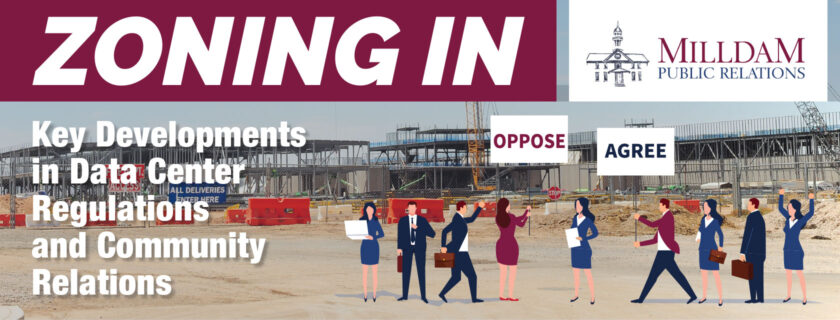
This week’s Zoning In makes one thing clear: opposition to data center development is no longer just a local land-use fight; it’s becoming a durable political force that will carry straight into 2026. From city councils rejecting projects despite heavy lobbying to moratoria, lawsuits, recalls, and even candidate recruitment efforts explicitly aimed at stopping data centers, community pushback is reshaping elections and policy conversations at every level. What’s especially striking is how this resistance is scrambling traditional political lines, creating strange bedfellows as progressive environmental groups, conservative rural voters, labor advocates, and ratepayer watchdogs increasingly find common cause around energy costs, transparency, and local control.
This growing political dimension is something I discussed in September with Rich Miller on the Data Center Richness Podcast, where we touched on how community sentiment, grid strain, and secrecy around deals are turning infrastructure into a ballot issue. If this week is any indication, the politics of data centers are only getting louder.
Virginia regulators weigh expanded use of data centers’ polluting generators
Virginia’s DEQ is weighing guidance that could broaden when data centers can run Tier II (dirtier) diesel backup generators, potentially treating certain utility “planned outages” as “emergencies.” Environmental groups and local officials warn that expanding allowable run-hours would worsen localized air and noise impacts—especially in areas already sensitive to ozone and pollution—while the industry argues reliability demands flexibility. The through-line: as grid constraints and transmission upgrades collide with nonstop uptime expectations, “backup power” is turning into a frontline permitting and public-health issue.
Fairfax County solidifies new rules for electrical substations as energy demand grows
Fairfax County unanimously adopted new zoning rules for future electrical substations, including a 100-foot setback from residential property lines, required 12-foot walls, landscaping buffers, formal noise studies, and tighter compliance with the county’s noise ordinance. The debate centered on how aggressively to buffer neighborhoods (staff recommended 100 feet; planning commissioners pushed 200), with supervisors ultimately prioritizing grid reliability and upgrade feasibility. Notably, the county is also steering substations toward industrial areas (by-right)—a sign that Northern Virginia’s “data center conversation” is increasingly shifting to the enabling infrastructure that makes new capacity possible.
Lewiston, ME city councilors unanimously vote down AI data center proposal
Lewiston’s city council unanimously rejected a proposal to convert a vacant mill into an AI data center, halting a $300M redevelopment plan that included tax incentives and discounted city-owned space. While developers framed the project as low-impact reuse, residents raised concerns about noise, water use, and electricity rates, and councilors said the proposal failed to earn sufficient community confidence. Adaptive reuse alone, the vote suggests, is no longer enough to overcome public skepticism.
Fortune frames the data center backlash as a widening political problem—less partisan than place-based—driven by concerns over noise, air pollution, land use, rising bills, and opaque dealmaking (NDAs, abatements, closed-door negotiations). The piece points to high-profile battlegrounds (notably Virginia) where data centers have already reshaped local elections and predicts the issue will spill into more state and federal races as AI-driven demand accelerates. The core takeaway: communities are increasingly asking a blunt question that incentives and “jobs” talking points don’t always answer—what do residents actually get in return for hosting infrastructure that serves global tech players?
Data centers have a political problem — and Big Tech wants to fix it
As voter backlash intensifies, Big Tech and the data center industry are ramping up political spending, lobbying, and messaging campaigns to reframe data centers as economic engines rather than environmental and ratepayer liabilities. POLITICO reports that trade groups are distributing talking points, organizing congressional field trips, and funding multimillion-dollar ad campaigns—particularly after recent elections where candidates won by campaigning against data center expansion. The piece underscores a major shift: data centers are no longer a quiet infrastructure issue, but a 2026 midterm liability forcing the industry into full-scale political defense.
Senators Elizabeth Warren, Chris Van Hollen, and Richard Blumenthal have launched a formal investigation into whether Big Tech data centers are driving up residential electricity bills by shifting grid upgrade costs onto consumers. The probe targets hyperscalers and major data center operators, demanding transparency around confidential utility agreements and cost allocation. The move signals that ratepayer impacts—long a local flashpoint—are now firmly a federal oversight issue, with potential implications for utility regulation and future project approvals.
In Port Washington, Wisconsin, opponents have initiated a recall effort against the mayor as construction begins on a controversial data center campus described as a $15B project. Organizers argue the development was advanced without sufficient local input; city leadership counters that the project is essential for long-term fiscal stability and reducing homeowners’ tax burden, and that much opposition is rooted in misinformation. The key takeaway is political: for some communities, the data center debate is no longer just a planning fight—it’s becoming an accountability fight, with elected officials directly in the line of fire.
Saline Township resident files lawsuit to stop massive data center project
A resident challenge is targeting the process behind a massive proposed “Stargate” campus—described as a multi-million-square-foot project tied to major AI/cloud tenants—by alleging violations of Michigan’s Open Meetings Act and improper approval steps related to a consent judgment. Beyond the scale and power-demand claims, the core issue here is governance and transparency: opponents are framing the project not just as “too big,” but as pushed forward through a process they argue lacked public votes and daylight.
Utility watchdogs accuse PGE of skirting new law meant to make data centers pay for rising demand
Oregon consumer advocates are accusing Portland General Electric of proposing a compliance approach that could shift long-term infrastructure costs back onto residential customers—despite a state law intended to ensure data centers pay for the grid investments required to serve them. The dispute centers on how costs get assigned over multi-decade asset life: watchdogs argue the utility’s framework charges data centers heavily early, then spreads much of the remaining cost across everyone later. This is the policy front of the same community debate: “Who pays” is becoming as contentious as “Where it goes.”
Sparta amends ordinance for future data center regulation
Sparta, Michigan moved to update its ordinance to define data centers explicitly, after local rumors triggered an outsized public response to what leaders emphasized was not an actual project vote. Officials argue the change is about gaining control—so a data center isn’t treated like a generic warehouse if a proposal appears—while residents raised familiar concerns about water, power, and safety. This is the “pre-battle” phase many towns are entering: codify definitions first, because once a real application arrives, the timeline accelerates fast.
Amid data center boom, commissioner wants Grand Rapids to be proactive
A Grand Rapids city commissioner is urging the city to get ahead of data center zoning as Michigan becomes a more active target for new proposals. City staff say they’re evaluating whether existing ordinances adequately address data centers or if they’re being treated too broadly as warehouse/industrial uses—an increasingly common gap as communities realize scale, power, water, and infrastructure impacts don’t fit legacy categories. The article also underscores a broader regional pattern: even without a formal proposal on the table, local officials are facing constituent pressure to define the rules before a project arrives.
People protest at the Grant County Courthouse against proposed data and solar center near Sheridan
Residents in Grant County, Arkansas are organizing early against a proposed combined data center (753 acres) and solar project (3,200 acres), citing quality-of-life concerns like noise, lighting, and property values—plus skepticism about tax incentives via a proposed PILOT arrangement. County leaders argue that negotiating terms may give them leverage over design and mitigation, while opponents worry the public ends up carrying the burden while the developer receives discounts. It’s a familiar pattern: the “deal terms” fight is happening in parallel with the land-use fight.
A human-impact story out of South Memphis spotlights residents living near xAI’s data center, describing fears about air quality and health impacts tied to power generation (including reports of gas turbines and permitting controversy). The article highlights ongoing tensions between local economic-development arguments (jobs/tax base) and community claims of pollution exposure and inadequate safeguards—especially in a historically overburdened neighborhood. This is the reputational risk version of the data center story: once public health and environmental justice narratives lock in, they’re hard to unwind.
Residents near potential South Bend data center site react
In South Bend, Indiana, residents are reacting to reports of a possible ten-building complex on ~300 acres, even as city officials continue to label the idea “speculative.” Early sentiment in the reporting is mixed-to-positive among a handful of nearby residents (jobs/development), but the bigger signal is how quickly community conversations ignite even without a confirmed application. This is another example of the new baseline: rumor alone now triggers organizing, because communities have learned that timelines can move fast once land control and preliminary agreements are in place.
West Virginia lawmakers offer no clear plan for addressing local concerns about data centers
West Virginia’s new pro-development framework is drawing sustained backlash from communities that say the law strips local authority over noise, lighting, land use, and redirects tax benefits away from host areas. While some leaders acknowledge the political heat and hint at possible tweaks, there’s no clear plan heading into the 2026 session—setting up a likely fight over transparency, disclosure (including water use), and restored local control. The storyline is blunt: the state is trying to compete for AI infrastructure, but communities are organizing around the perception that they’re being asked to absorb impacts without decision-making power.
Birmingham sets public hearing on temporary moratorium for data centers
Birmingham, Alabama is moving toward a temporary moratorium on data centers, scheduling a January 2026 public hearing to assess environmental, infrastructure, and economic impacts. City leaders emphasized that the pause is about education and due diligence—not rejection—mirroring a growing national trend where municipalities slow approvals to reassess zoning, power, water, and workforce implications before projects advance.
STAMP data center could jack up power bills
A newly proposed 2.2M-square-foot, 500-MW data center at New York’s STAMP megasite is drawing intense scrutiny over its potential to raise electricity costs statewide and crowd out other industrial users. Investigative Post reports that the facility could consume power equivalent to nearly all homes in Erie County, while seeking substantial public subsidies. Opposition from the Tonawanda Seneca Nation and environmental groups centers on energy burden, noise, and environmental review—reviving a fight that previously forced the developer to withdraw a smaller proposal.
Michigan township limits where data centers can be built
Ypsilanti Township has unanimously amended its zoning code to restrict data centers to industrial and commercial revitalization districts, citing increased scale, power demand, water use, and noise from modern hyperscale facilities. Officials concluded that data centers are now an incompatible land use in lighter zoning categories—a clear example of communities rewriting codes to reflect how dramatically the infrastructure has changed in just a few years.
Union City data center proposal draws heated, overcrowded council meeting
A proposed rezoning for a data center in Union City, Georgia triggered an overflow council meeting, fueled by resident organizing on social media. While city leadership emphasized tax revenue and economic development, opponents argued the project belongs in industrial zones—not mixed-use areas—and warned about environmental and consumer cost impacts. The outcome remains uncertain, but the packed chamber reflects how fast community mobilization now happens once a proposal surfaces.
Opposed to data centers? The Working Families Party wants you to run for office
The Working Families Party is actively recruiting anti-data-center organizers to run for office, citing rising public outrage over electricity costs, environmental impacts, and secrecy around deals. WIRED reports that opposition to data centers has become an electoral issue in places like Virginia, Arizona, and the Midwest—powerful enough to flip races and reshape local politics. The article reinforces a central theme of this week’s Zoning In: data centers are no longer just land-use fights—they’re candidate-making issues.
Residents pack meetings to protest Microsoft’s potential data center plans
In West Michigan, opposition to Microsoft’s potential data center plans has grown so large that township meetings are being rescheduled to larger venues to meet fire code limits. Even when data centers aren’t formally on the agenda, residents are showing up to voice concerns about water, noise, and environmental impacts—a signal that community awareness has reached a tipping point well before applications are filed.
Michigan regulators conditionally approved DTE’s request to fast-track power contracts for the proposed OpenAI–Oracle data center near Ann Arbor, allowing the project to bypass a full contested-case review under rules meant to protect other ratepayers. The Michigan Public Service Commission said the contracts shift billions of dollars in risk onto the project itself and include safeguards to prevent costs from landing on customers, while critics argue the process lacked transparency and deserved deeper environmental and financial scrutiny given the project’s gigawatt-scale power demand.
NKY landowner refuses $8 million offer from potential data center to preserve family land
A Northern Kentucky landowner near Maysville turned down escalating offers—reportedly up to $8M+—from a would-be AI data center buyer seeking to assemble roughly 2,000 acres, saying the land’s value to his family outweighs the money. Local economic development leaders suggest the project is competing across multiple locations, with a decision expected by mid-2026. This story lands because it’s personal: it frames AI infrastructure not as an abstract “growth engine,” but as a direct test of land, legacy, and community identity.
Athens film studio wants to reboot as a data center
A Georgia film-studio developer in Athens is proposing a major pivot: converting the Athena Studios campus into a data center footprint that could reach roughly 1.3M square feet, after a sharp production slowdown left much of the state’s soundstage capacity sitting empty. The plan is running straight into a regulatory gap—Athens-Clarke County doesn’t yet have a formal “data center” zoning definition—and local leaders have already moved to pause new data center approvals while they draft standards. The story is a snapshot of a wider trend: as market conditions shift, underutilized industrial/creative real estate is increasingly being repositioned for AI infrastructure—often faster than local zoning can adapt.
